Corporate
Governance
Information on our corporate governance is posted here.
Information on our corporate governance is posted here.
Information on our corporate governance is posted here.
OHARA’s Management Philosophy is that “The OHARA Group continually seeks to instill new value and build a strong organization for the purpose of advancing the well-being of its people and contributing to the prosperity of society,” and we conduct our business activities in accordance therewith. OHARA endeavors to streamline internal organizational structure and administrative schemes and take necessary measures to realize the above Management Philosophy. Moreover, toward The Board of Directors consists of eight directors and meets once a month in principle. As a management decision-making body, the Board makes decisions on important matters such as management policies and supervises the execution of duties by our various stakeholders including customers, shareholders, investors, suppliers, employees, and local communities, OHARA strongly believes that fulfilling responsibility as a public instrument of society will maximize our corporate value, and management with transparency and soundness in line with our corporate philosophy is the best approach to corporate governance.
Based on the intent and spirit of the Corporate Governance Code, OHARA has established the “Basic Policies on Corporate Governance,” with the objective of pursuing the best corporate governance and its enhancement, for the sustainable growth and the improvement in the corporate value of the OHARA Group.
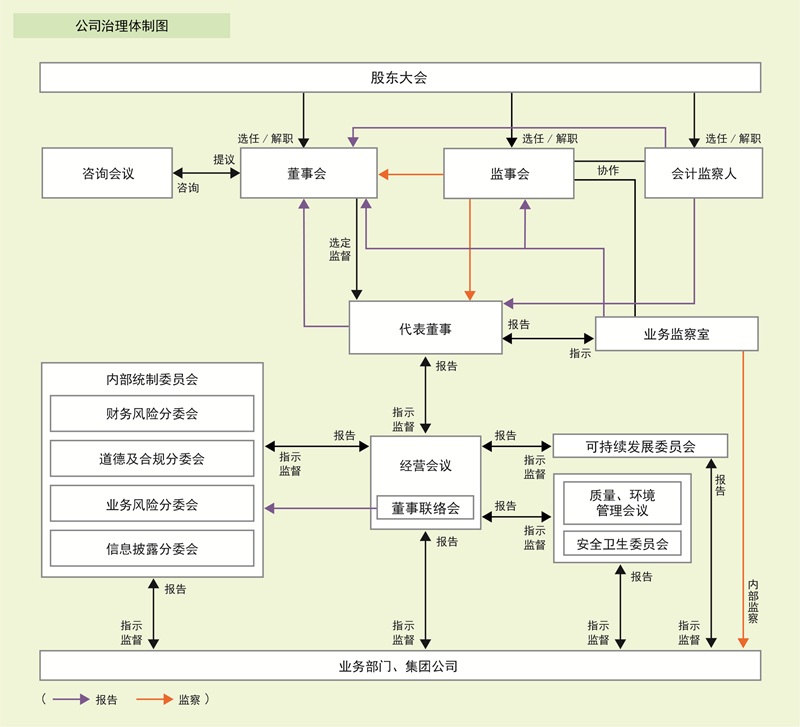
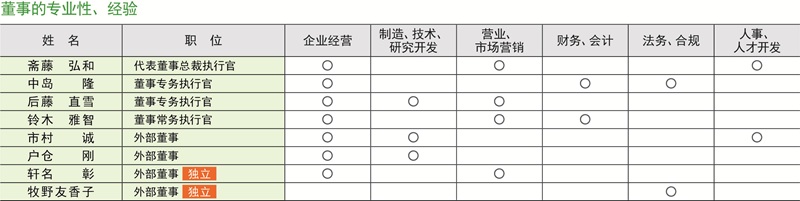
The Board of Directors consists of eight directors and meets once a month in principle. As a management decision-making body, the Board makes decisions on important matters such as management policies and supervises the execution of duties by directors and executive officers. The Board of Directors currently consists of four full-time directors and four outside directors (including one female).
Two of the outside directors are independent outside directors.
OHARA evaluates the effectiveness of the Board of Directors in accordance with its Basic Policies on Corporate Governance. In the analysis and evaluation for FY 2025, full-time officers (directors and audit & supervisory board members) made self-evaluation based on a questionnaire, and then opinions of independent outside directors were heard, after which the Board of Directors had discussions and carried out analysis and evaluation by referring to the collected results. A summary of the results of this analysis and evaluation follows. Regarding the FY 2025 issue of “Selecting important matters such as management strategies and growth strategies, incorporating them into the annual plan, and improving their effectiveness,” we assessed those key topics, including business structural reforms, were selected and discussed to a certain extent.
On the other hand, we assessed that there is still room for improvement in regard to the depth of discussion on these important matters. We recognized that the ongoing challenge is to further deepen deliberations on essential themes for the OHARA Group, and to ensure that decision-making and oversight effectively function to contribute to the sustainable enhancement of corporate value.
The Audit & Supervisory Board comprises four audit & supervisory board members, three of whom are outside members. In accordance with the audit policy and other guidelines formulated by the Audit & Supervisory Board, the Board audits the directors’ execution of their duties by attending the Board of Directors and other key meetings and by investigating the status of operations and assets.
The names of the audit & supervisory board members are as follows:
Yoshihiro Harada (Chairman, Audit & Supervisory Board Member)
Taku Yoneyama (Outside Audit & Supervisory Board Member)
Minoru Asada (Outside Audit & Supervisory Board Member)
Yoshinari Iizuka (Outside Audit & Supervisory Board Member).
The Advisory Council is established as a voluntary body and consists of the chairman of the Board of Directors and three independent officers (two independent outside directors and one independent outside audit & supervisory board member). It works to ensure management objectivity and transparency by deliberating and reporting on matters regarding the appointment and dismissal of senior management (executive officers concurrently serving as directors), appointment of directors and audit & supervisory board members, and remuneration of directors.
The Internal Control Committee, chaired by President and Chief Executive Officer, has been established to check and strengthen the status of internal controls whose four purposes are to improve the effectiveness and efficiency of operations, ensure the reliability of financial reporting, comply with laws and regulations, and preserve assets. There are four subcommittees under the Internal Control Committee: the Financial Risk Subcommittee, the Ethics and Compliance Subcommittee, the Business Risk Subcommittee, and the Information Disclosure Subcommittee. The Internal Control Committee monitors internal controls of the OHARA Group as a whole, including these subcommittees.
◦ Financial Risk Subcommittee
The Financial Risk Subcommittee is in place to establish and build a system for ensuring the appropriateness and efficiency of the OHARA Group’s operations as well as the reliability of financial reporting. The subcommittee considers and supervises action plans and measures to improve the effectiveness and efficiency of operations and ensure the reliability of financial reporting.
◦ Ethics and Compliance Subcommittee
The Ethics and Compliance Subcommittee is in place to establish an ethics and compliance system for the OHARA Group as a whole and to realize corporate governance that fulfils its social responsibility through the execution of fair and appropriate business activities. The subcommittee practices the OHARA Group’s philosophy based on its corporate principles by providing educational programs related to ethics and compliance to raise awareness about legal compliance and ethics and prevent iniquity.
◦ Business Risk Subcommittee
The Business Risk Subcommittee is in place to effectively and efficiently manage risks of the OHARA Group. The subcommittee designs policies, systems, and measures pertaining to the Group’s risk management, raises awareness about the prediction and prevention of potential risks, formulates and operates annual risk management plans, conducts overall coordination of risks of departments and subsidiaries, and studies measures to minimize damage in the event of crises.
◦ Information Disclosure Subcommittee
The Information Disclosure Subcommittee is in place to disclose important financial, social, and environmental management-related information about the OHARA Group in a fair, timely, and appropriate manner. The subcommittee fulfils corporate accountability and ensures management transparency by considering whether a specific piece of management-related information constitutes a material fact that should be disclosed and taking appropriate measures.
The Sustainability Committee discusses policies and measures pertaining to the OHARA Group’s medium- to long-term sustainability initiatives. Recommendations based on those discussions are made by the Management Council, which makes decisions on policies and specific actions for realizing sustainability.Important matters concerning sustainability are deliberate and supervised by the Board of Directors.
Policy for determining officer remuneration
1. Determination policy
◦ Remuneration must function as a sound incentive for the officer’s contributions to sustainable growth.
◦ Remuneration must firmly instill the officer with a commitment to meeting shareholder expectations by maximizing corporate value.
◦ Remuneration must appropriately reflect the officer’s responsibilities.
2. Remuneration system and structure
Remuneration for directors (excluding outside directors) comprises basic remuneration and variable remuneration (performance-based remuneration and a medium- to long-term incentive).
The ratio of these depends on the position held but is set at 7:3 when the performance indicator coefficient is 1.
3.Basic remuneration
Basic remuneration is determined according to position and is paid as fixed remuneration.
Remuneration for non-executive directors and audit & supervisory board members consists of basic remuneration only, as these officers are independent from the execution of business operations.
4.Performance-based remuneration
In order for performance-based remuneration to function as an incentive for achieving the medium-term management plan’s goals and the medium- to long-term improvement of corporate value, it is linked to the company’s short-term business performance, employee engagement scores, which are a non-financial indicator, and the director’s degree of contribution to that performance.
The amount of consolidated operating income, the growth rate of consolidated net sales, and the rate of change in the employee engagement scores are used as indicators.
The system is designed so that the weight of performance-based remuneration in the total remuneration package increases with the
director’s position.
◦Formula for calculating performance-based remuneration

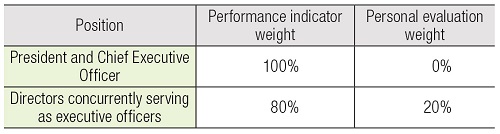
◦ Performance-based remuneration weight
(Performance-based remuneration = Performance indicator-based remuneration + Personal evaluation-based remuneration)
◦Performance indicator coefficients
The company assigns a range of 0.3 to 3.0 for each indicator: consolidated operating income amount, consolidated net sales growth
rate, and the rate of change in the employee engagement score.
The method for determining these coefficients is annually deliberated and decided by the Board of Directors based on the business plan.
◦ Personal evaluation coefficient
This coefficient is set in the range 0.5 to 1.5 based on evaluation of the director’s achievement of their expected mission and their division’s goals.
As for the method for determining the coefficient, the personal evaluations for directors other than the representative director (excluding outside directors) are decided by the President and Chief Executive Officer, who first solicits the opinions from the Advisory Council (a voluntary body comprising the President and Chief Executive Officer and independent outside officers), and bases the decisions on the content of the Council’s report. These decisions are reported to the Board of Directors.
5. Medium- to long-term incentive (stock compensation)
The medium- to long-term incentive for directors (excluding outside directors) is a stock compensation plan implemented through a Board Benefit Trust (BBT).
Stock compensation is awarded by points where one point is equivalent to one share of the company’s common stock. The number of points awarded is based on position and increases with the position.
The number of points is reviewed every three years.

PDF files are in Adobe’s Portable Document Format.
To view them you need Adobe® Reader® by Adobe Systems Incorporated.
Related information can be viewed by following the links below.
The contents about Investor Relations are explained.